Jesse Jackson Biography: Civil Rights Icon and Rainbow PUSH Founder Dies at 84
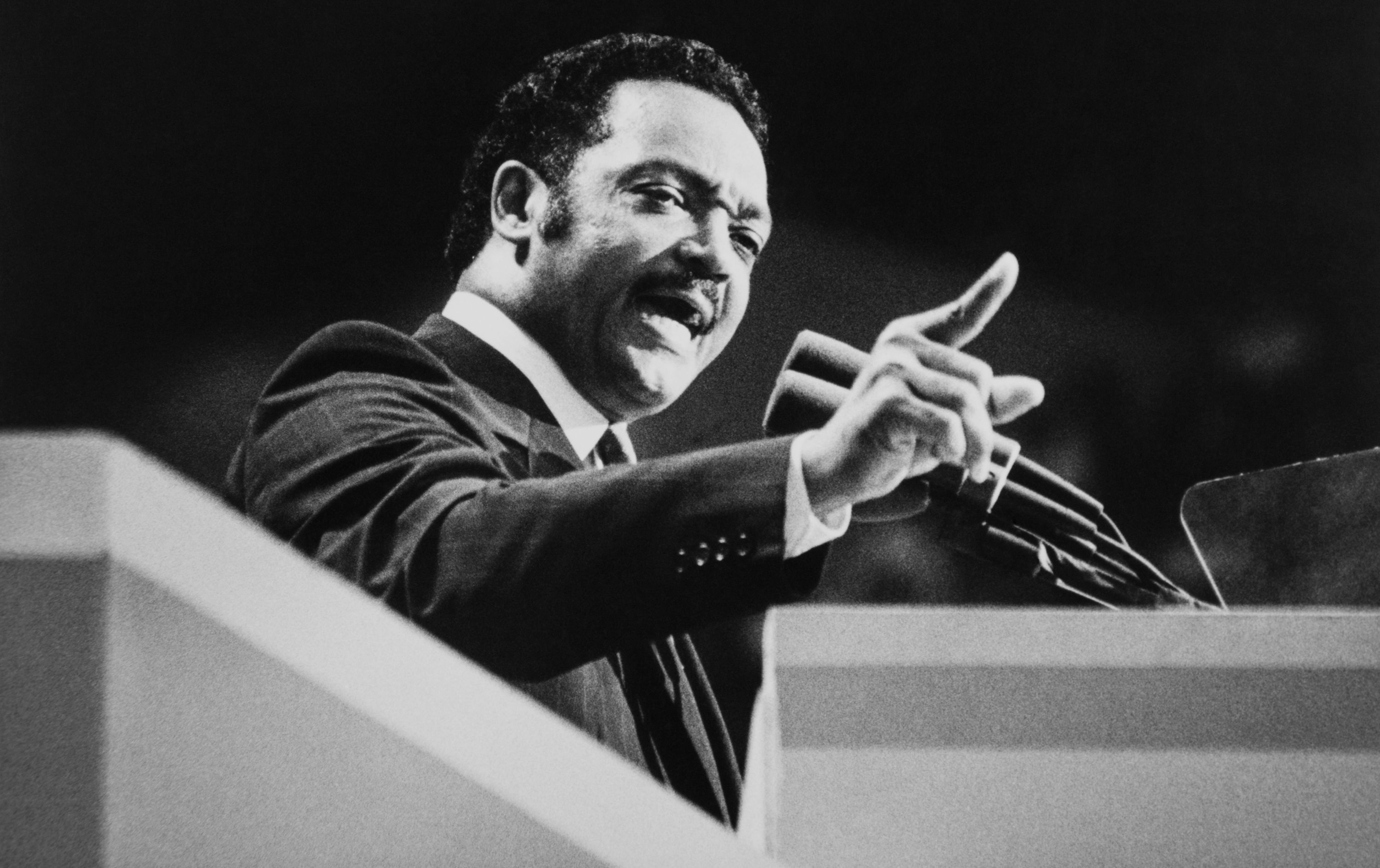
“If you fall behind, run faster. Never give up, never surrender, and rise up against the odds.”
— Jesse Jackson
Jesse Louis Jackson was born on October 8, 1941, in Greenville, South Carolina, to Helen Burns and Noah Louis Robinson. His mother was just sixteen years old, unmarried, and living next door to the man who would become Jackson’s father. The circumstances of his birth would have lasting personal significance—Jackson has spoken openly about the stigma of being labeled “a nobody’s child” growing up in the segregated South, and that pain became a driving force behind his lifelong commitment to the dignity and worth of every human being.
When Jesse was two years old, his mother married Charles Henry Jackson, a postal worker, who adopted him. The family lived in a poor but close-knit African American community in Greenville, where the brutal realities of Jim Crow segregation were inescapable. From an early age, Jesse showed fierce intelligence and competitive drive. He excelled in school and earned a football scholarship to the University of Illinois in 1959, but transferred after one year to North Carolina Agricultural and Technical State University (NC A&T) in Greensboro—a historically Black university—where he felt more at home and could play quarterback.
At NC A&T, Jackson discovered his voice as a leader. He was elected student body president, became a star athlete, and was drawn into the nascent civil rights movement that was electrifying Black college campuses across the South. He graduated in 1964 with a degree in sociology, and the course of his life was set.
The Civil Rights Movement
After graduating, Jackson enrolled at Chicago Theological Seminary, intending to become a minister. But his calling was pulled in two directions at once—toward the pulpit and toward the streets. In 1965, he left seminary to join the Southern Christian Leadership Conference (SCLC), the organization led by Dr. Martin Luther King Jr., and participated in the historic Selma to Montgomery voting rights marches. The experience was transformative. Jackson absorbed King’s oratory, his theology of nonviolent resistance, and his belief that the church had an obligation to speak to power.
King recognized Jackson’s exceptional gifts and appointed him to head Operation Breadbasket in Chicago, the SCLC’s economic justice arm that used boycotts and negotiations to pressure white-owned businesses to hire Black workers and stock Black-owned products. Under Jackson’s leadership, Operation Breadbasket became one of the most effective economic empowerment campaigns in the country, securing thousands of jobs and hundreds of thousands of dollars in contracts for the Black community.
On April 4, 1968, Jackson was present at the Lorraine Motel in Memphis, Tennessee, when Dr. Martin Luther King Jr. was assassinated. The moment left an indelible mark on Jackson and deepened his sense of obligation to carry the movement forward. He was twenty-six years old. The weight of what he had witnessed—and what had been lost—would shape everything that followed.
READ MORE: June 3 Disaster: 11 years on, Ghana remembers a tragedy that must never be forgotten
Operation PUSH and the Rainbow Coalition
In 1971, after a period of tension with the SCLC leadership, Jackson founded Operation PUSH—People United to Serve Humanity—in Chicago. The organization broadened his economic justice work, combining community organizing, advocacy for Black entrepreneurship, and moral leadership rooted in the Black church tradition. Saturday morning PUSH meetings at the Chicago headquarters became legendary events, featuring Jackson’s electrifying preaching style, celebrity guests, and a spirit of collective purpose that drew thousands of followers.
Through PUSH, Jackson launched initiatives like PUSH-Excel, a program targeting education in inner-city schools. He traveled to high schools across the country, delivering his signature exhortation—“I am somebody”—urging young Black students to affirm their own worth in the face of a society that too often denied it. The chant became an iconic expression of the movement’s spiritual core and Jackson’s particular genius for marrying inspiration with activism.
Jackson also made an early mark in international affairs, traveling to the Middle East in 1979 and generating controversy—and later, credit—for meeting with PLO Chairman Yasser Arafat at a time when such dialogue was deeply taboo in American politics. He argued that peace required engaging adversaries, not just allies. It was a principle he would apply again and again in the decades to come.
Presidential Campaigns: 1984 and 1988
Jesse Jackson’s campaigns for the Democratic presidential nomination in 1984 and 1988 stand as two of the most significant moments in the history of American electoral politics. They permanently altered what was possible—and who was considered possible—in the race for the White House.
1984: The First Run
When Jackson announced his 1984 candidacy, much of the political establishment dismissed it as symbolic. He proved them wrong. Running under the banner of the “Rainbow Coalition”—a vision of a broad, multicultural progressive movement—Jackson won primary contests in South Carolina, Louisiana, and Washington, D.C., and earned 3.5 million votes, placing third for the party’s nomination. The campaign was also clouded by controversy when Jackson used the term “Hymie” to refer to Jewish people, remarks he ultimately apologized for, though the episode damaged his relationship with the Jewish community for years.
1988: The Second Run
The 1988 campaign was a different story entirely. Jackson ran a more disciplined, more ideologically coherent campaign, and the results were stunning. He finished second in the Democratic primary, winning eleven primary contests and caucuses, earning 6.9 million votes—nearly 30 percent of all Democratic primary votes—and amassing 1,218.5 delegates. He won the Michigan primary, shocking the political world. For a period in the spring of 1988, Jesse Jackson was the frontrunner for the Democratic presidential nomination.
His address to the 1988 Democratic National Convention in Atlanta is remembered as one of the great pieces of American political oratory. “Common ground!” he thundered, calling on Americans across lines of race, class, and region to recognize their shared humanity. Jackson’s campaigns reshaped American politics: they dramatically increased Black voter registration and turnout, and helped make conceivable what had seemed inconceivable—that a Black American could seriously contend for the nation’s highest office. Scholars and politicians, including Barack Obama, have acknowledged the path that Jackson’s campaigns helped open.
Diplomat Without Portfolio
Throughout his career, Jackson demonstrated a willingness to engage with some of the world’s most difficult and dangerous situations—often traveling where official U.S. diplomacy feared to tread. In 1984, he traveled to Syria and successfully negotiated the release of Navy Lieutenant Robert Goodman, an African American pilot shot down and held prisoner by Syrian forces. In 1990, on the eve of the Gulf War, Jackson traveled to Iraq and convinced Saddam Hussein to release hundreds of Western hostages. In 1999, he flew to Yugoslavia during the NATO bombing campaign and helped secure the release of three captured American soldiers. These were not symbolic gestures—they were lives saved.
READ MORE: Algeria U17 stage comeback to hold Black Starlets to a draw in AFCON opener
Later Years and Health Struggles
Jesse Jackson continued his activism well into the twenty-first century, championing causes ranging from criminal justice reform to tech industry diversity. His Rainbow PUSH Coalition successfully pressured major Silicon Valley companies to release diversity data and commit to more inclusive hiring practices. In 1991, he was elected as one of Washington, D.C.’s two “shadow senators,” serving one term to lobby for D.C. statehood. In 2000, President Bill Clinton awarded him the Presidential Medal of Freedom.
In his final years, Jackson battled a series of serious health conditions. In 2017, he publicly disclosed a diagnosis of Parkinson’s disease. In April 2025, doctors confirmed a further diagnosis of progressive supranuclear palsy (PSP), a severe neurodegenerative condition similar to Parkinson’s. That November, he was hospitalised in Chicago for complications from PSP, prompting widespread concern about his condition. His family issued statements clarifying he was not on life support, and he was released after several weeks. He was hospitalised again in December 2025 before returning home. Through it all, Jackson remained surrounded by his family and the community he had served for more than six decades. In March 2025, just months before his final hospitalisation, he had made a public appearance in Selma, Alabama, to commemorate the 60th anniversary of “Bloody Sunday.”
Death: February 17, 2026
The Reverend Jesse Louis Jackson Sr. died peacefully on the morning of Tuesday, February 17, 2026, at the age of 84, surrounded by his family. His family announced his passing in a statement: “It is with profound sadness that we announce the passing of civil rights leader and founder of the Rainbow PUSH Coalition, the Honorable Reverend Jesse Louis Jackson Sr. He died peacefully on Tuesday morning, surrounded by his family.” No cause of death was formally cited, though Jackson had been managing progressive supranuclear palsy for his final months of life.
“Our father was a servant leader—not only to our family, but to the oppressed, the voiceless, and the overlooked around the world,” the Jackson family said. “We shared him with the world, and in return, the world became part of our extended family. His unwavering belief in justice, equality, and love uplifted millions.”
Tributes poured in from across the political spectrum and around the world. Civil rights leader Reverend Al Sharpton, who has described Jackson as the man who “first called me into purpose when I was just twelve years old,” posted a moving tribute: “Today, I lost the man who first called me into purpose when I was just twelve years old. And our nation lost one of its greatest moral voices. The Reverend Dr. Jesse Louis Jackson was not simply a civil rights leader; he was a movement unto himself.” Public commemorations were announced to take place in Chicago, the city that had been his home and headquarters for more than half a century.
Legacy
Jesse Jackson’s life was defined by contradiction as much as conviction—the preacher and the politician, the visionary and the self-promoter, the man who fought for the marginalized and who sometimes marginalized others with careless words. He was celebrated and condemned, sometimes in the same breath. But his impact on American life is beyond dispute. He helped transform the Democratic Party’s relationship with its Black voters. He conducted citizen diplomacy that saved lives. He helped make the rhetoric of inclusion—the insistence that everyone belongs at the table—a central feature of mainstream American political discourse.
His two presidential campaigns marked the most successful White House bids by any Black candidate prior to Barack Obama’s historic election in 2008. Obama openly wept in the crowd in Chicago on election night 2008—a moment that, for many, completed the arc that Jackson’s own campaigns had bent toward possibility. The path from “I am somebody” to “Yes we can” is, in no small measure, a path that Jesse Jackson helped forge.
For generations of Black Americans and other marginalised people, Jesse Jackson embodied the fierce, unapologetic belief that their lives and their voices mattered. The chant he carried from high school auditorium to convention hall—“I am somebody”—was not merely a slogan. It was a declaration of fundamental human dignity, and Jesse Jackson spent his entire life insisting the world make good on it. He was 84 years old.
Edem Kwame
Edem Kwame is a journalist at GH News Media covering features and national developments in Ghana.