Chuck Norris Death: How did he die? Full biography and legacy
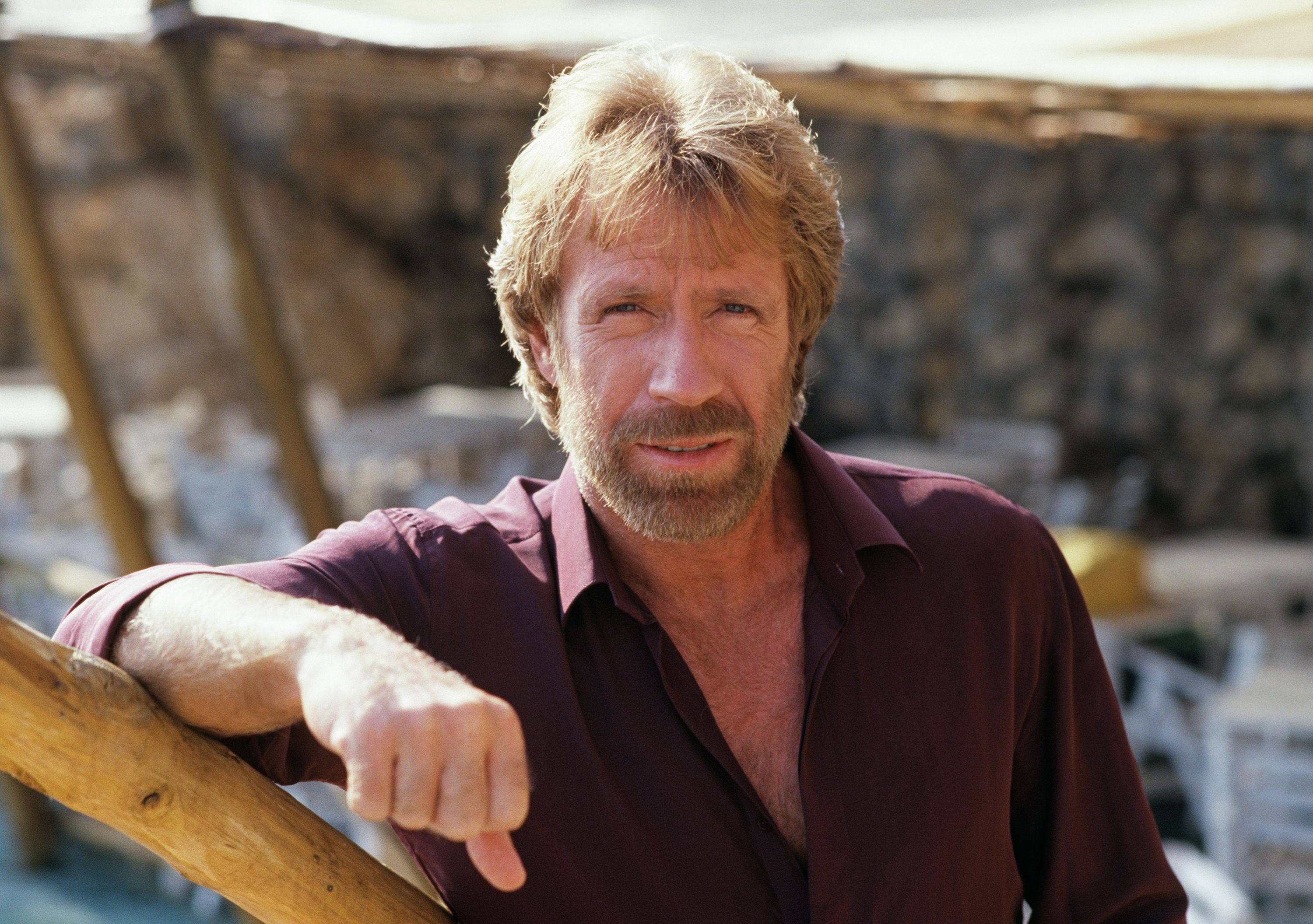
Carlos Ray "Chuck" Norris was one of the most recognisable and beloved figures in American popular culture for more than half a century. A world-champion martial artist, Hollywood action hero, decorated U.S. Air Force veteran, bestselling author, devoted philanthropist, and an unlikely internet legend, Norris embodied a distinctly American ideal: the self-made man who, through relentless discipline and force of will, overcomes all odds. He passed away on March 19, 2026, at the age of 86 in Hawaii, surrounded by his family. The world mourned not just a film star but also a cultural institution.
1. Early Life and Origins
Chuck Norris was born Carlos Ray Norris on March 10, 1940, in Ryan, Oklahoma, a small oil-boom town that had seen better days. His mother, Wilma Lee (née Scarberry; 1921–2024), was a warm and deeply religious homemaker of Irish descent who would prove to be the most stabilising force in young Carlos’s life. His father, Ray Dee Norris (1918–1971), a World War II Army veteran, struggled chronically with alcoholism and drifted between work as a mechanic, bus driver, and truck driver. The family’s financial circumstances were precarious and frequently strained by his father’s unreliability.
Norris had Irish and Cherokee Native American heritage on both sides of his family tree. His paternal grandfather and maternal grandmother were of Irish descent, while his paternal grandmother and maternal grandfather were Cherokee. He was named after Carlos Berry, his father’s minister.
He was the eldest of three boys. His younger brothers, Wieland and Aaron, would both figure prominently in his life – Wieland tragically, as a casualty of the Vietnam War, and Aaron as a family anchor. Carlos later described himself as "the shy kid who never excelled at anything in school", a portrait of an introverted boy living in the long shadow of a difficult home.
A Childhood of Hardship and Movement
When Norris was sixteen, his parents divorced, and the family began a period of migration. They moved briefly to Prairie Village, Kansas, before ultimately settling in Torrance, California, in the early 1950s. The Southern California sun did little, at first, to ease the anxieties Norris carried. He was an unremarkable student — quiet, insecure, and without a particular sense of direction — attending North Torrance High School, where he met the girl who would become his first wife.
Military Service and the Discovery of Martial Arts
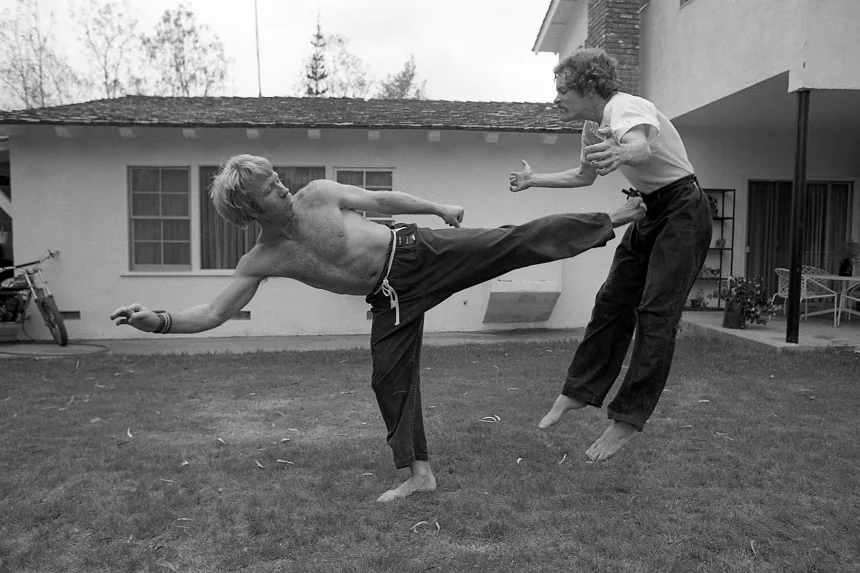
In 1958, the same year he married his high school sweetheart Dianne Holechek, Norris enlisted in the United States Air Force. He was assigned to Osan Air Base in South Korea, where he served as a military policeman. It was in Korea that two formative things happened: he acquired the nickname "Chuck" — given to him by a barracks mate, it stuck for life — and he was introduced to the martial art of Tang Soo Do, a Korean discipline emphasising the use of open-hand strikes and kicks.
Norris was immediately drawn to the precision and philosophy of martial arts. He trained with dedication throughout his posting and also began studying judo. By the time he received his honourable discharge in 1962, he had earned a first-degree black belt in Tang Soo Do and a third-degree brown belt in judo — a remarkable achievement in just four years.
The Transition to Civilian Life
Returning to California, Norris took a job as a file clerk at the defence contractor Northrop Corporation, hoping eventually to join the police force. While waiting to sit the entrance exam, he taught karate out of his mother’s backyard. The demand surprised him. He took out a loan and opened his first formal Chuck Norris karate school in Torrance. What followed was a rapid expansion: throughout the 1960s, he opened more than 30 karate studios across California, building a loyal following and beginning to attract celebrity students, including Priscilla Presley; entertainer Bob Barker (who reportedly broke two ribs during one workout); and actor Steve McQueen, whose encouragement would prove decisive to Norris’s future.
A Champion in the Ring
Norris did not merely teach martial arts — he competed ferociously at the highest levels. Through the mid-1960s and into the 1970s, he amassed an extraordinary record in open competition, winning state, national, and international titles. In 1968, he was honoured as Competitor of the Year, and, on November 24, 1968, after suffering – and avenging – the tenth and final loss of his competitive career, he defeated Louis Delgado to claim the Professional Middleweight Karate Championship. He would hold that title for six consecutive years.
He was the first person ever voted into the Black Belt Hall of Fame and retired from competition undefeated in 1974. His final distinction came in 1997, when he became the first man in the Western Hemisphere — in 4,500 years of Tae Kwon Do tradition — to be awarded an 8th-degree black belt grandmaster in Tae Kwon Do. He also held a 10th-degree black belt in tang soo do.
The Chuck Norris System
Even while competing, Norris was evolving his own martial art philosophy. He studied Shōtōkan, Gōjū-ryū, Shitō-ryū, Kyokushin, Brazilian Jiu-Jitsu, Hapkido, Taekwondo, Arnis, and American Kenpo, synthesising these traditions into a hybrid system he initially called Chun Kuk Do, formally founded in 1990. The system later became known as the Chuck Norris System, emphasising self-defence, competition, weapons, grappling, and fitness. In 1990, he also founded the United Fighting Arts Federation (UFAF), a worldwide organisation that grew to include more than 3,300 black belts across the globe. The UFAF holds annual training conferences and world championship tournaments in Las Vegas.
The Meeting with Bruce Lee
While on the competitive circuit, Norris forged a relationship that would define the early part of his public career. He met Bruce Lee – at the time gaining recognition through the TV series The Green Hornet – and the two developed a friendship built on mutual respect, a shared passion for martial arts, and long hours of training together. Lee, who was serving as an adviser on the film The Wrecking Crew, introduced Norris to the film world. Their friendship would produce one of cinema’s most celebrated fight sequences.
Hollywood Career
Norris entered the film industry almost by accident, but the transition proved fortuitous. His first screen credit came in 1969 in The Wrecking Crew, starring Dean Martin, in which he appeared as a bodyguard. His raw physicality and natural on-screen intensity were unmistakable, even in a supporting role.
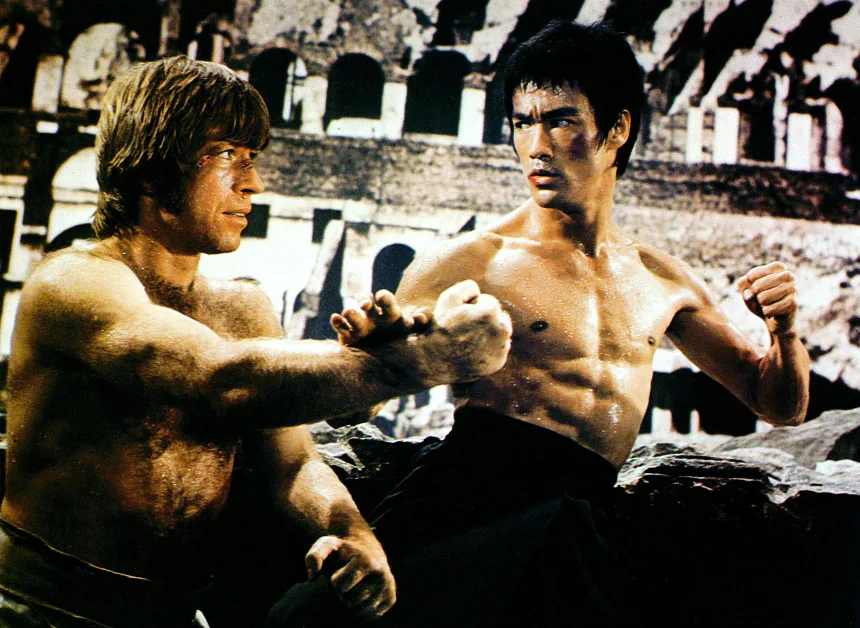
His watershed moment came in 1972 with Bruce Lee’s The Way of the Dragon (released in the U.S. as Return of the Dragon). The centrepiece of the film was a sprawling, vicious fight between Lee and Norris staged inside the Roman Colosseum — a scene that became one of the most iconic in martial arts film history and that catapulted Norris to global attention. Tragically, Lee died in 1973, before he could see the full impact of the film’s success.
The 1970s: Building a Career
Norris’s first starring role came in 1977 with Breaker! Breaker!, a low-budget action film in which he played a truck driver searching for his kidnapped younger brother. The film performed well at the box office on a minimal budget, establishing the basic formula that Norris would refine throughout the decade: a stoic, physically formidable hero delivering justice against long odds. Further films followed — Good Guys Wear Black (1978) and An Eye for an Eye (1981) — cementing his reputation.
READ MORE: Hilda Baci named Guinness World Records icon after historic cooking achievements
The 1980s: Peak Hollywood Stardom
Norris reached the height of his cinematic powers in the 1980s, becoming one of the defining action stars of the decade alongside Sylvester Stallone and Arnold Schwarzenegger. His partnership with Cannon Films, the Israeli-American production company then at its commercial zenith, proved enormously profitable. The films were unapologetically patriotic, tapping into the nationalistic mood of the Reagan era:
Missing in Action (1984): Norris played Colonel James Braddock, a former Vietnam POW who returns to Southeast Asia to rescue American soldiers still held captive. The film grossed $22 million against a $2.5 million budget and spawned two sequels. It was, Norris said, a tribute to his younger brother Wieland, who was killed in combat in Vietnam in 1970.
Code of Silence (1985): Frequently cited as his finest purely dramatic film, it cast him as a maverick Chicago cop fighting both a gang war and police corruption. Critics who had dismissed his earlier work gave the film warmer notices.
Invasion U.S.A. (1985): A high-concept thriller in which Norris single-handedly repels a Soviet-backed terrorist invasion of American soil. It grossed over $17 million domestically.
The Delta Force (1986): Co-starring the legendary Lee Marvin — one of the genuine giants of American cinema — the film depicted a fictional counter-terrorism mission inspired by the real-life hijacking of TWA Flight 847. It was among his highest-grossing films.
Walker, Texas Ranger (1993–2001): A Television Institution
By the early 1990s, Norris’s box-office appeal had begun to fade, as the audience’s appetite for the muscular action films of the Reagan years softened. Rather than disappear, Norris made a strategic pivot to television — and struck gold. Walker, Texas Ranger, which premiered on CBS in April 1993, became one of the most successful and long-running action series in American broadcast history.
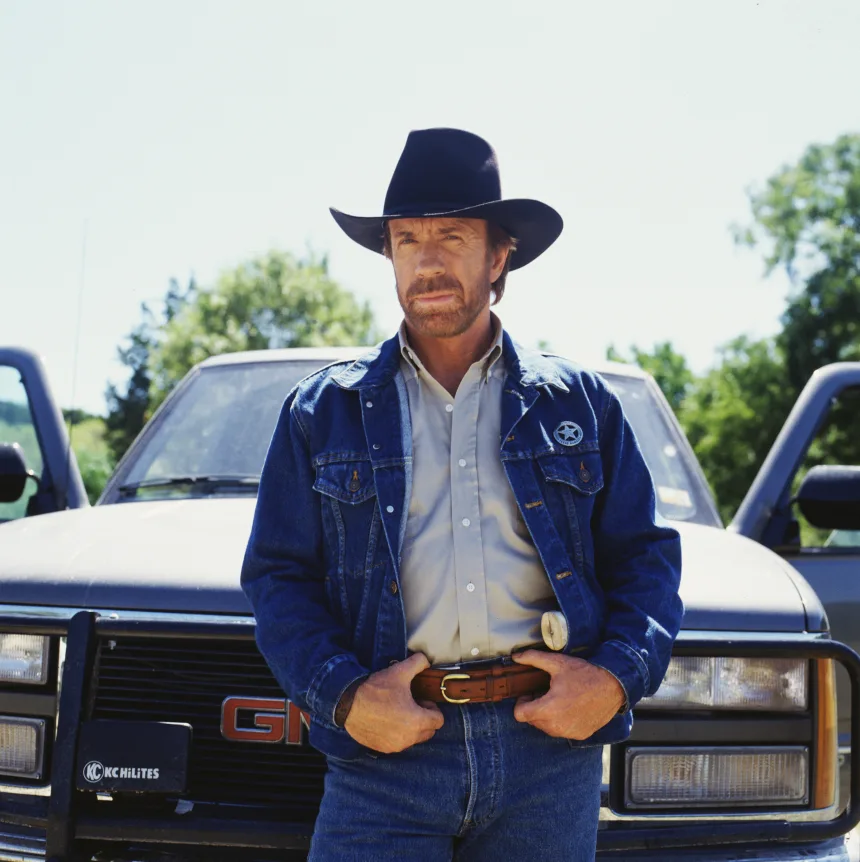
Norris played Sergeant Cordell Walker, a steely-eyed, morally unimpeachable Texas Ranger who dispensed justice with his fists, a roundhouse kick, and an old-school moral code. The show ran for nine seasons and 201 episodes, blending martial arts action with family-friendly stories, patriotic themes, and Norris’s own personal values. It was still performing solidly in the ratings when it ended in 2001. In 2005, he returned to the role for the CBS TV movie Walker, Texas Ranger: Trial by Fire.
Later Film Appearances
Although he largely retired from acting after 2005, Norris made several notable returns to the screen in his later years. In 2012, he appeared in The Expendables 2 alongside Sylvester Stallone, Arnold Schwarzenegger, Jason Statham, Jet Li, and Bruce Willis — an all-star action reunion that grossed more than $310 million worldwide. His last film credit, Agent Recon, came in 2024.
Personal Life and Family
In December 1958, Norris married Dianne Kay Holechek, his high school sweetheart from North Torrance High School. He was 18; she was 17. The marriage endured for three decades, during which Norris rose from obscurity to international stardom, and Dianne largely remained in the background, raising their family. They had two sons: Mike Norris, born in 1962, who became an actor and director, and Eric Norris, born in 1965, who became a stuntman and NASCAR driver.
The marriage ended in 1989. In his 2004 memoir, Norris acknowledged that while stationed in California during his Air Force days, he had fathered a daughter, Dina (born 1962), from a relationship outside the marriage. Dina and Norris met for the first time in 1990, and he publicly acknowledged her in the memoir. Dianne Holechek passed away in December 2025, just months before Chuck.
Second Marriage: Gena O’Kelley
In 1997, while out at dinner in Dallas, Norris encountered a former model named Gena O’Kelley. By his own account, he was on a date with someone else. He was so captivated that the following day he invited Gena to the Walker, Texas Ranger set, where she played a small guest role. He asked her to dinner that night. Their relationship deepened rapidly; he later wrote in his memoir: "Before long, I felt myself falling head over heels in love."
On November 28, 1998, Chuck, aged 58, and Gena, aged 35, were married — beginning a partnership of nearly three decades. On August 30, 2001, Gena gave birth to fraternal twins: a son, Dakota Alan Norris, and a daughter, Danilee Kelley Norris. Dakota went on to earn a fifth-degree black belt in Chun Kuk Do. In the years after Chuck’s passing, Danilee honoured her father in a moving public tribute, describing him as "my safe person" and saying, "My dad was my protector the moment I was born. He loved so deeply and cared for every single person in his life with so much tenderness."
Chuck and Gena lived on a ranch in Navasota, Texas, near Houston, where they shared a life built around faith, family, fitness, and philanthropy. In later interviews they described daily walks on the ranch, shared meditation and prayer, joint workouts, and a mutual commitment to healthy ageing. Gena survived serious health challenges of her own, which Norris publicly cited as a defining reason for stepping back from acting and public life after 2005.
Philanthropy and Public Service
Perhaps Norris’s most enduring and meaningful off-screen achievement was the organisation now known as Kickstart Kids. Founded in 1990 under the original name the Kick Drugs Out of America Foundation and renamed Kickstart Kids in 2003 alongside Gena, the nonprofit uses martial arts training as a vehicle for character development and youth empowerment in Texas schools. Recognised by the Texas Education Agency as a physical education provider, the programme is delivered in middle and high schools across the state.
By the time of Norris’s death, Kickstart Kids had reached more than 100,000 children, giving young people from at-risk backgrounds a structured path toward self-esteem, discipline, and academic engagement. Norris and Gena served as co-chairs and were deeply personally involved in its operation. CForce Bottled Water, the company he and Gena founded in 2012 after an aquifer was discovered on their ranch, channelled a portion of its revenue to Kickstart Kids and environmental causes.
READ MORE: Beverly Afaglo funeral set for August 7, 2026
Other Charitable Causes
Norris was a long-standing donor and ambassador for the Make-A-Wish Foundation and the United Way and made regular contributions to the Veterans Administration National Salute to Hospitalised Veterans and other organisations supporting military families. In 2005, he founded the World Combat League (WCL), a team-based full-contact martial arts competition, a portion of whose proceeds were directed to Kickstart Kids.
Faith, Politics, and Writing
Chuck Norris was an outspoken and deeply committed Christian, specifically a Baptist and a member of Prestonwood Baptist Church in Dallas, part of the Southern Baptist Convention. His faith was not a late-life adoption but a lifelong pillar — shaping his personal code of honour in martial arts, his values in on-screen roles, and his philanthropic commitments.
He authored several books with Christian themes, appeared on Christian television, and frequently spoke about his faith in public forums. His personal code, embedded in the Chuck Norris System, included guiding principles such as "I will always remain loyal to my God, my country, family and my friends" and "I will look for the good in all people and make them feel worthwhile."
Conservative Politics
Norris was one of Hollywood’s most prominent and active political conservatives. He campaigned for multiple Republican presidential candidates, including Mike Huckabee in 2007–2008, and later Ted Cruz and Mitt Romney. He wrote a regular column for the conservative outlet WorldNetDaily and published a book, Black Belt Patriotism: How to Reawaken America (2008), which laid out his vision for an America grounded in traditional values, personal responsibility, and faith.
Author and Memoirist
Norris published nine books in total across a remarkable range of genres: martial arts manuals, fitness guides, political commentary, Christian western fiction, self-help titles, and two memoirs — The Secret of Inner Strength: My Story (1988) and Against All Odds: My Story (2004), the latter of which included his first public acknowledgement of his daughter Dina.
Cultural Icon and Internet Phenomenon
In 2005, an unlikely second cultural life began for Chuck Norris when a college student named Ian Spector began posting satirical one-liners online under the rubric "Chuck Norris Facts". The format was simple but brilliantly calibrated: absurdist, hyperbolic claims about Norris’s toughness, virility, and invincibility. "Chuck Norris doesn’t read books. He stares them down until he gets the information he wants.") The meme spread with viral speed, eventually inspiring two video games, multiple books, and talk-show appearances.
Rather than protest or distance himself from the joke, Norris embraced it. He publicly shared his favourites ("Before the Boogie Man goes to sleep, he checks his closet for Chuck Norris" was reportedly his preferred), appeared on late-night television to deliver them himself, and brought them to morale-boosting visits with U.S. troops in Iraq. In doing so, he demonstrated a self-awareness and good humour that endeared him to an entirely new generation of fans who might never have seen a Walker, Texas Ranger episode.
In his final public post on Instagram, made just days before his death, Norris posted a video of himself sparring outdoors in Hawaii and captioned it with characteristic wit: "I don’t age. I level up." It was a fitting last message from a man who had, against all odds, remained genuinely larger than life.
Honours, Awards, and Legacy
Hollywood Walk of Fame: Norris received his star on the Hollywood Walk of Fame in 1989, recognising his contributions to the entertainment industry.
Honorary Texan: In 2017, the state of Texas formally honoured him as an "Honorary Texan" in recognition of his long association with the state, his ranch in Navasota, and his portrayal of a Texas Ranger.
ActionFest Lifetime Achievement Award: In 2010, he received the Lifetime Achievement Award from ActionFest, the leading film festival dedicated to the action genre.
Martial Arts Hall of Fame: He was the first person ever voted into the Black Belt Hall of Fame, a distinction that preceded and superseded all his Hollywood accolades in his own estimation.
Budapest Statue: In 2024, sculptor Mihály Kolodkó erected a small bronze statue of Norris at the eastern end of the Megyeri Bridge in Budapest, Hungary — a testament to his global cultural reach.
Military Honours: Texas Governor Greg Abbott was among the first public officials to pay tribute upon Norris’s passing, calling him a "legend" whose influence extended far beyond Hollywood.
Death and Tributes
On March 19, 2026, just nine days after his 86th birthday, Chuck Norris suffered a sudden medical emergency while in Hawaii and was hospitalised. His family confirmed his passing the following morning. While the precise medical circumstances were kept private at the family’s request, their statement noted that he died peacefully, surrounded by loved ones.
His family’s announcement read in part: 'To the world, he was a martial artist, an actor, and a symbol of strength. To us, he was a devoted husband, a loving father and grandfather, an incredible brother, and the heart of our family. He lived his life with faith, purpose, and an unwavering commitment to the people he loved.' Through his work, discipline, and kindness, he inspired millions around the world and left a lasting impact on so many lives."
Edem Kwame
Edem Kwame is a journalist at GH News Media covering entertainment and national developments in Ghana.